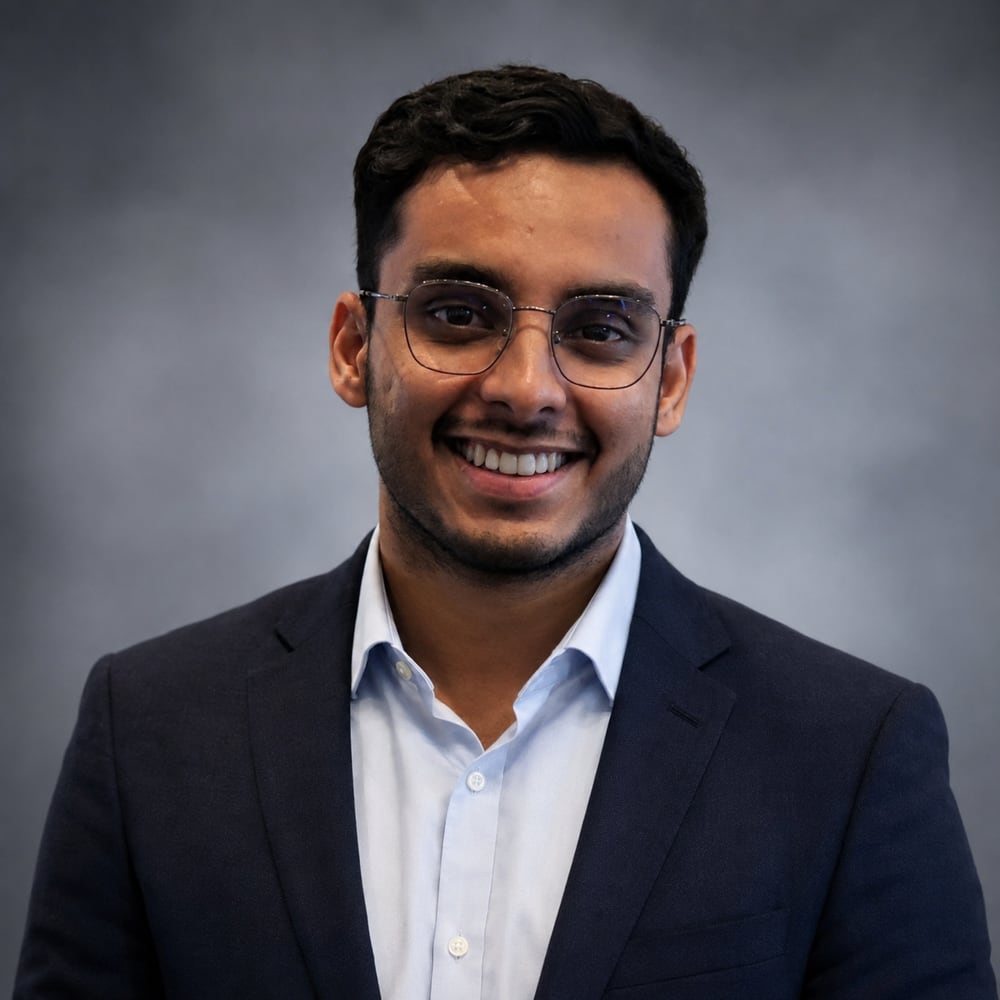
Now
I lead engineering for Neome, Kotak Neo's AI assistant that explains stocks, funds, IPOs, F&O and the day's market in plain language. I built its first working version myself, and then the team and I took it from a first prototype to daily use by retail investors in the Kotak Neo app. Today I lead three engineers, and I still build some of its key parts. I have written more about the role on its own page, leading an AI assistant into daily use.
Product thinking is a big part of my job. We work alongside the product team, and ideas come from everyone. I bring many of them, and so does the rest of the team. We discuss them and quickly build the ones that add value. My engineering team runs its own user-level analysis, production monitoring and model evaluation, so what real users do shapes every decision about what to build and what to cut.
I can't share numbers from my day job, as they belong to my employer. I will be glad to walk you through the methods and trade-offs on a call. What I can show in public is how I work. The practice is in my notes, and the same habits, applied to projects outside my job, are in my work.
Before
Before Kotak, I worked on technology for rural India. I did an M.Tech in Technology & Development at IIT Bombay, where my research looked at sensing groundwater use over powerlines with IoT, and at low-cost smart irrigation. Then an IIT Bombay technology fellowship placed me inside the Ministry of Rural Development in New Delhi.
After the fellowship, I worked on government data platforms, including real-time reporting with national, state and district dashboards. Then I moved to backend engineering at Kotak Innovation Lab, on retail investing products in Java and Spring, before taking on Neome in 2024.
Timeline
May 2024 – present
GenAI Engineering Lead (Sr. Manager)
Kotak Securities (now Kotak Neo) · Mumbai
Lead engineering for Neome, the AI assistant retail investors use daily in the Kotak Neo app. I built its first working version myself and now lead three engineers. I lead its technical direction and co-designed our test automation with my team; we decide every release on its results. My engineering team runs its own user analysis, monitoring and model evaluation, alongside the product team.
Jan 2023 – May 2024
Backend Engineer
Kotak Securities
Backend engineering for retail investing products (Java, Spring).
Jul 2022 – Jan 2023
Senior Research Fellow
Ministry of Agriculture & Farmers Welfare
Senior Research Fellow in the Office of the Secretary.
Jul 2021 – Jun 2022
R&D Fellow (IIT Bombay CTARA fellowship)
Ministry of Rural Development · New Delhi
IIT Bombay CTARA technology fellowship, placed inside the Ministry of Rural Development, in the MGNREGS Division.
Aug 2019 – Jul 2021
M.Tech, Technology and Development
IIT Bombay · Mumbai
Applied research: IoT groundwater-usage sensing over powerlines, and low-cost smart irrigation.
Aug 2014 – Jul 2018
B.E., Computer Science
UIT RGPV · Bhopal
Bachelor of Engineering in Computer Science.
How I work
I like to work across the whole product, from the idea and the design to the code.
I start from the person who will use it, sketch the interface, shape the architecture, and write and review code. At work, I do this with my team and the product team; on most of my own projects, I do all of it myself. AI coding agents help me move faster, so more ideas reach real users, but deciding what is good, and when it is done, is still a human call.
- Product first
- Everything I build starts with the people who will use it, like retail investors at work, riders who want a better record of their rides, a relative whose books existed only as print files, and a hobby community splitting parcels from Japan. How they use it decides what gets built and what gets left out. On my own projects I make that call, and at work we make it as a team.
- Design by hand
- In my experience, AI is weakest at the parts that need a feel for the person using them, so I design those myself. That means navigation that feels natural with a TV remote, Hindi text set for readers over fifty, and a ride replay you can read on a phone at a glance.
- Every layer
- I have built backends on Java and Cloudflare Workers, frontends and Android apps, an AI model running on one graphics card, a TV app, and LEDs I soldered for my parents’ TV.
- Measured, then corrected
- I test a change side by side with the old version before I believe it. When the logs disagreed with me on Piaa, I retracted three of my own conclusions and published the corrections.
- Always building
- Since February 2026, alongside a full-time lead role, I have built a reader for my relative’s books, a group-buy tool with Vinayak and Yash, a voice assistant, a ride tracker, an unofficial F1 app for LG TVs, and ambient lighting. A desk robot for Piaa is next.
Each square is a week of the past year on my GitHub. The stronger the colour, the more code I wrote that week.
Off the clock
I make things, mostly for people I know, and I keep the same habits when I do. I co-built PlamoGB, an unofficial group-buy tool for the Gunpla community, with Vinayak and Yash. Slipstream turns phone GPS into ride replays. Lights Out is an F1 companion app for LG TVs (unofficial, and not affiliated with Formula 1).
makranddubey.com is a library of Hindi books rebuilt from print files, shared with the author's permission. For my parents' TV, I soldered an ambient light strip on a perfboard, running stock WLED. It was my first soldering project, and it lives in the lab.