In short
Neome is the AI assistant in the Kotak Neo app. Investors ask it about stocks, funds, IPOs, F&O and the day's market, and it explains the numbers plainly. I built its first version, now lead three engineers and still build key parts. I bring many of its product ideas, and together we build the ones that add value.
What Neome does
Neome is the AI assistant in the Kotak Neo app, for people investing in Indian markets. Kotak Securities renamed its retail business Kotak Neo in October 2026, so older articles use the old name. You ask Neome in plain words, and it answers in plain words:
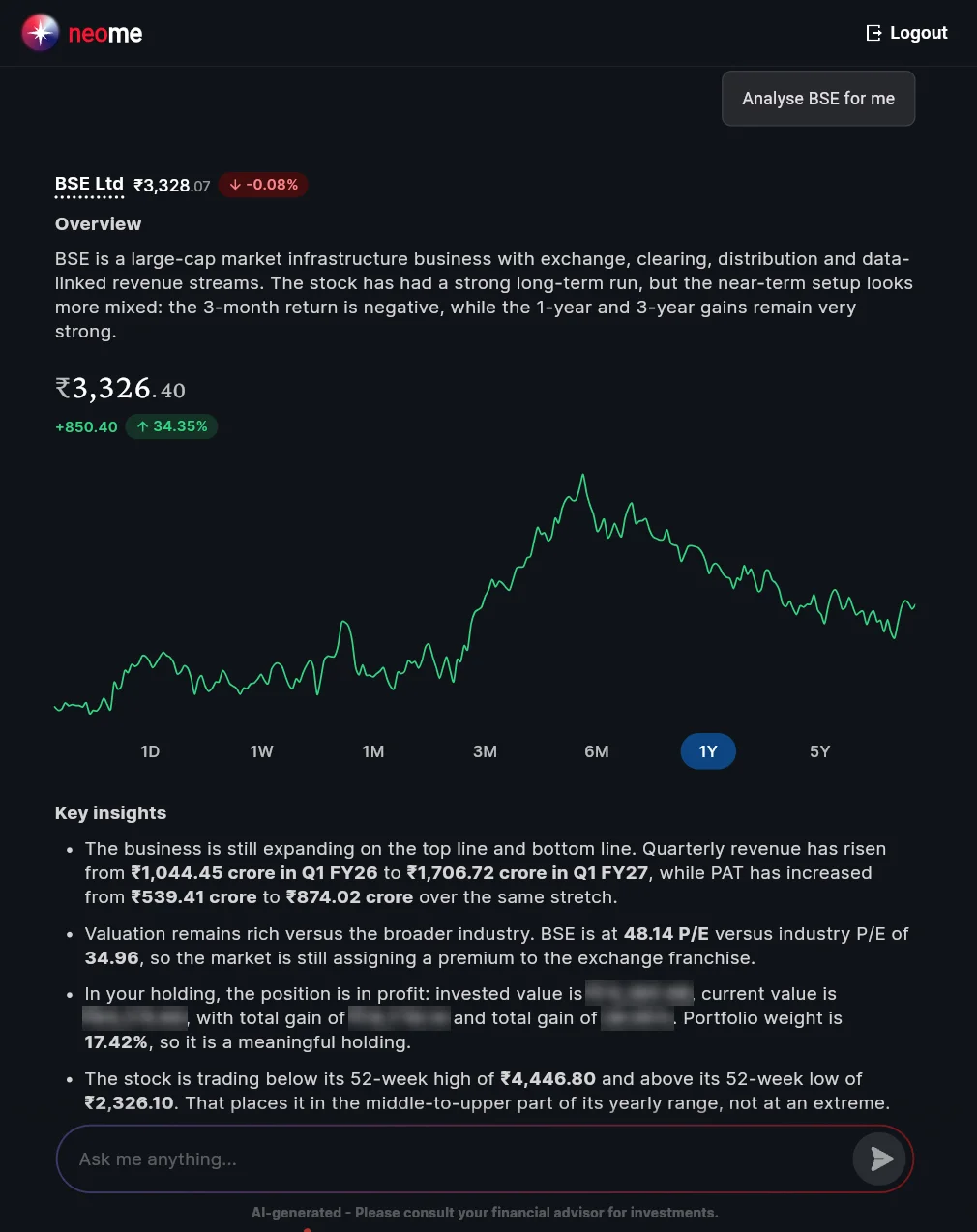
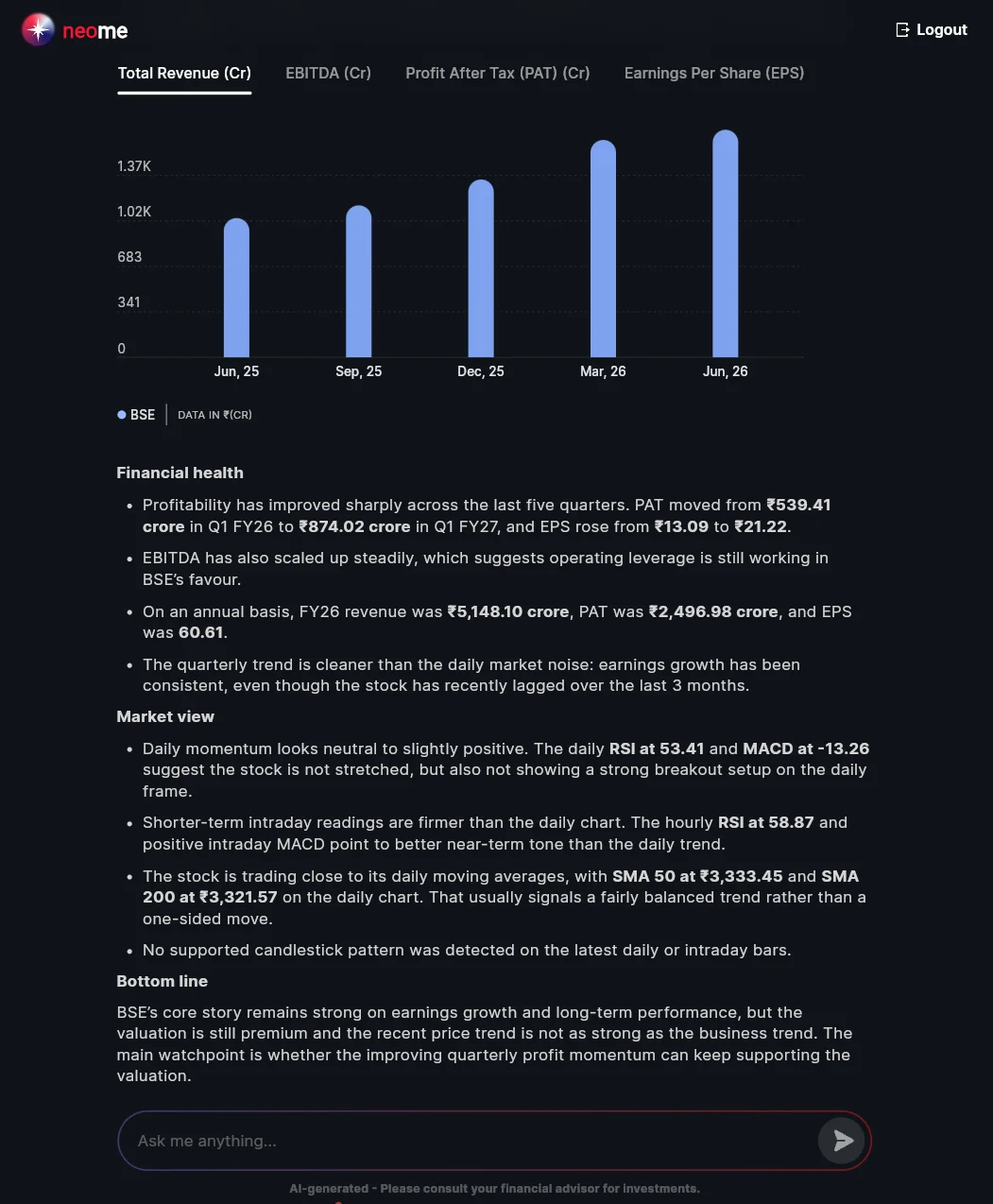
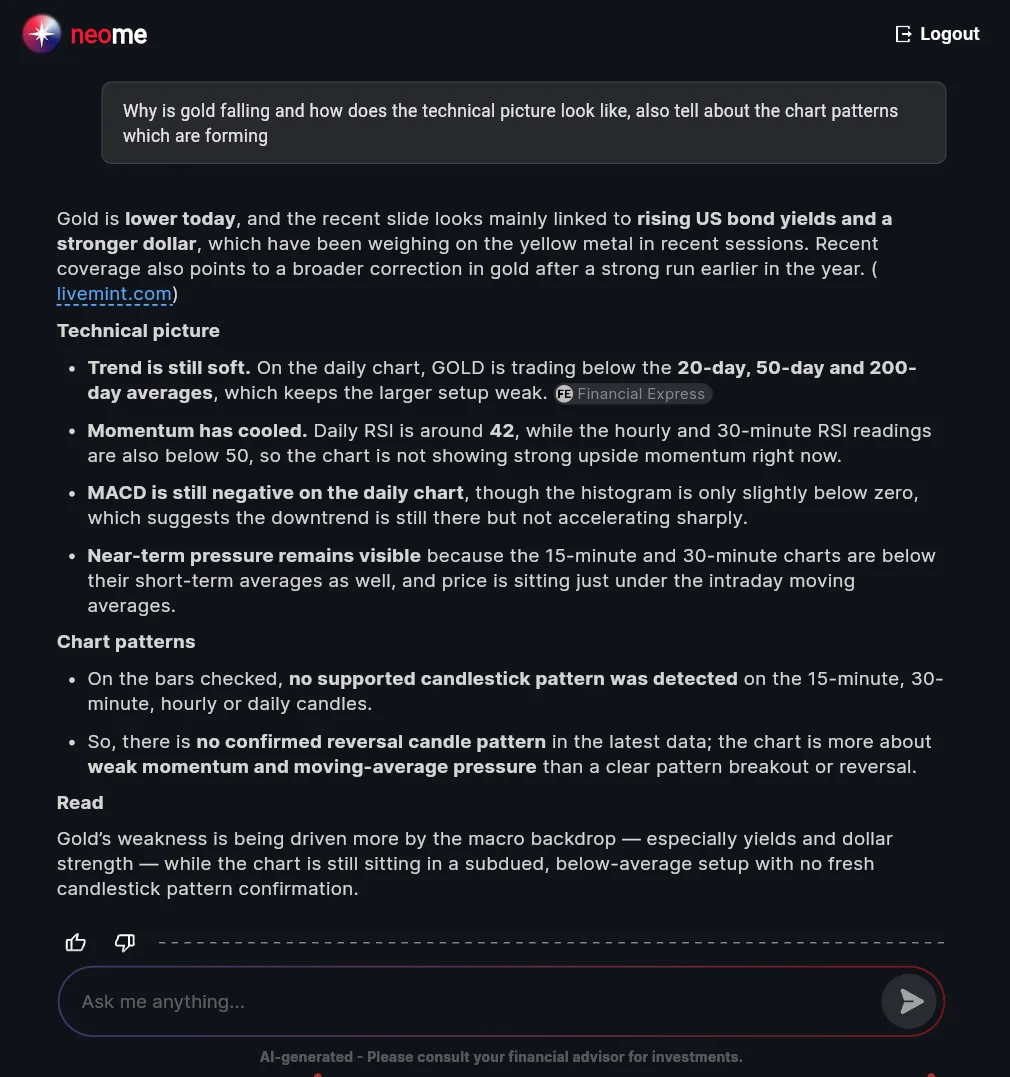
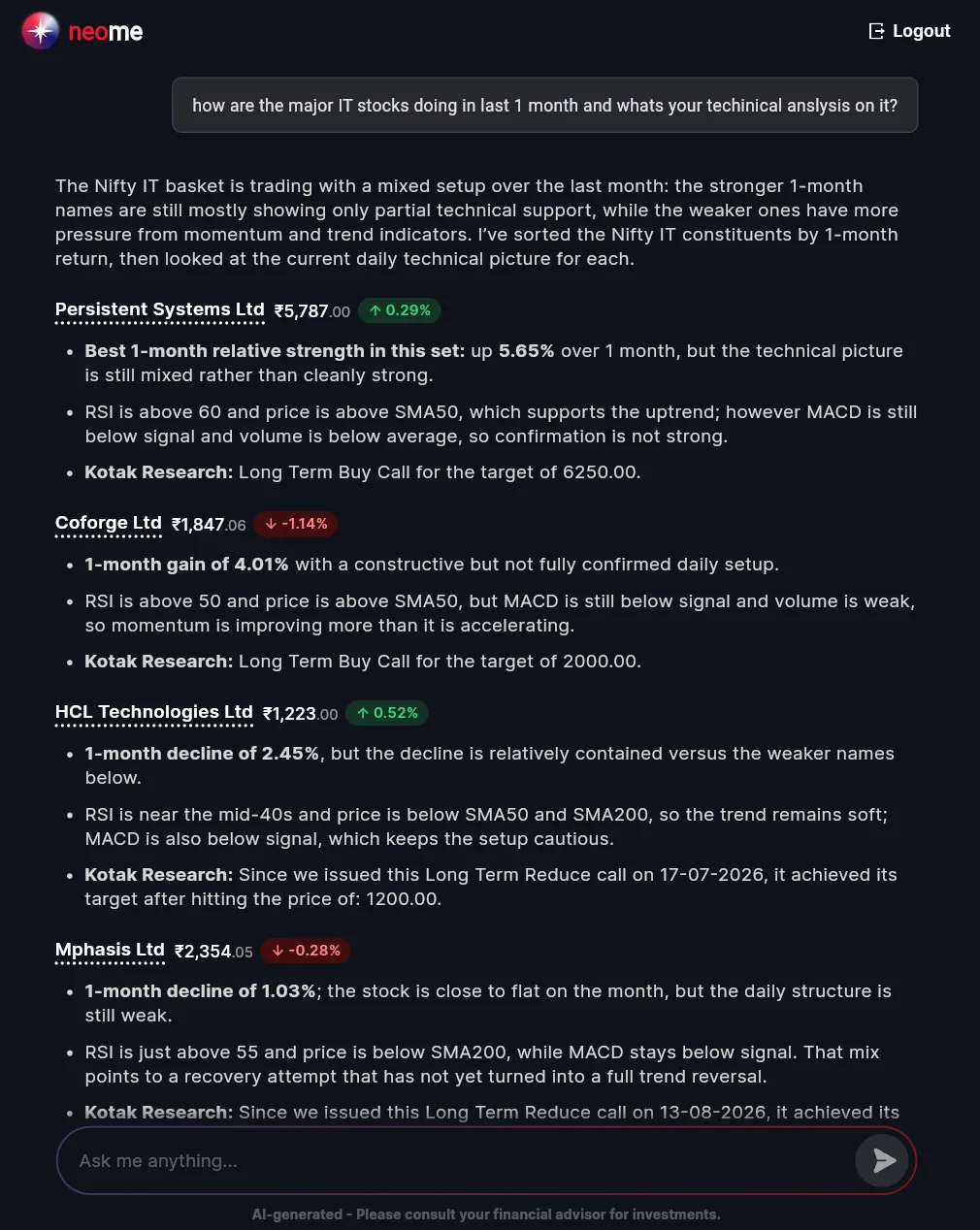
- Stocks: what the company does, its financials with charts, the technical picture across timeframes, and Kotak Research's view where there is one. It can also line up a group, like the major IT stocks, and compare them.
- Mutual funds and ETFs: what they hold, what they track and how they're built.
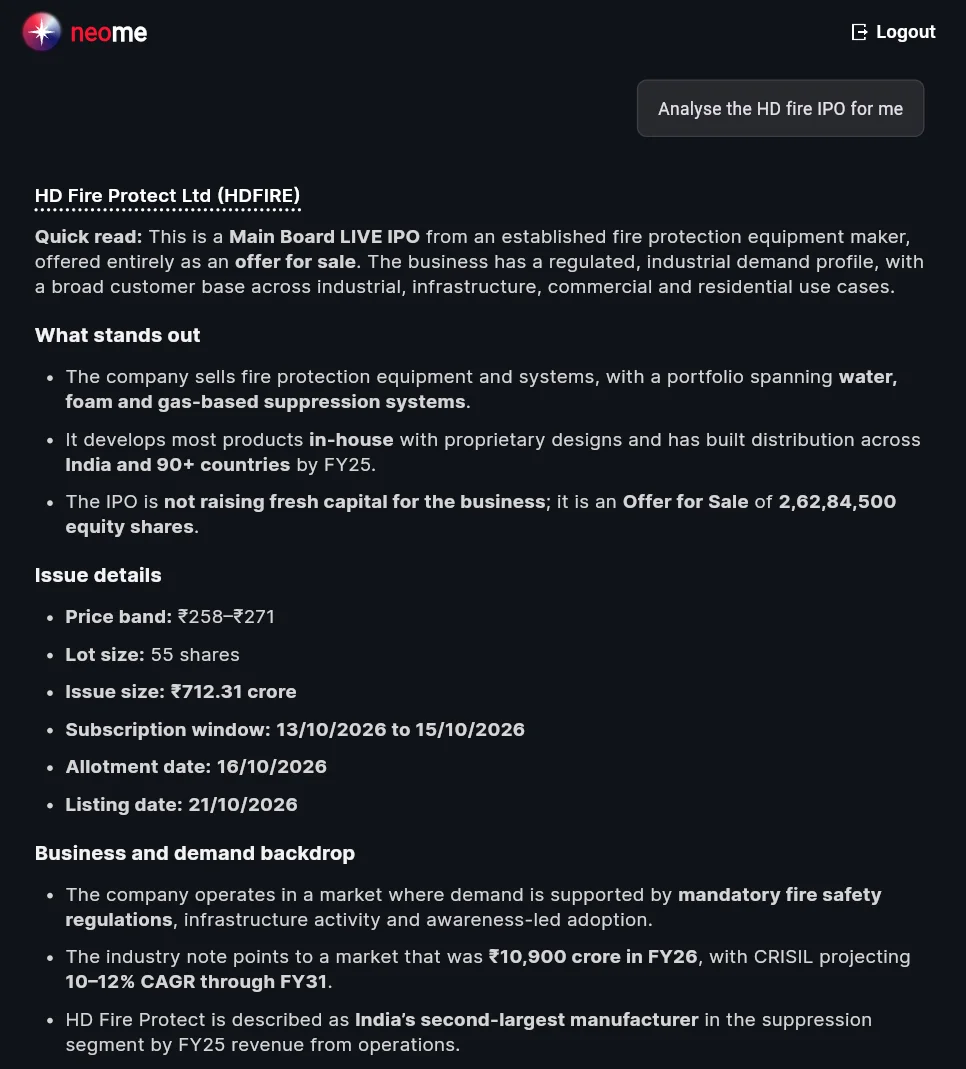
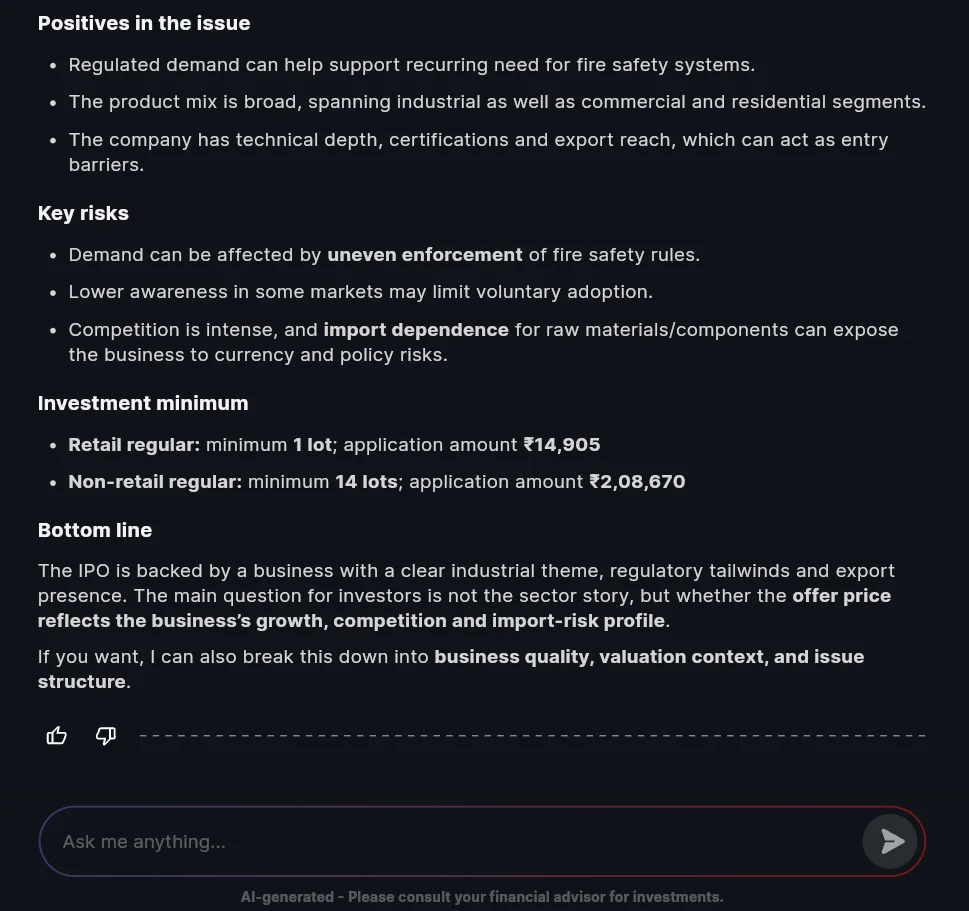
- IPOs: the company, the price band, the dates and how much it has been subscribed.
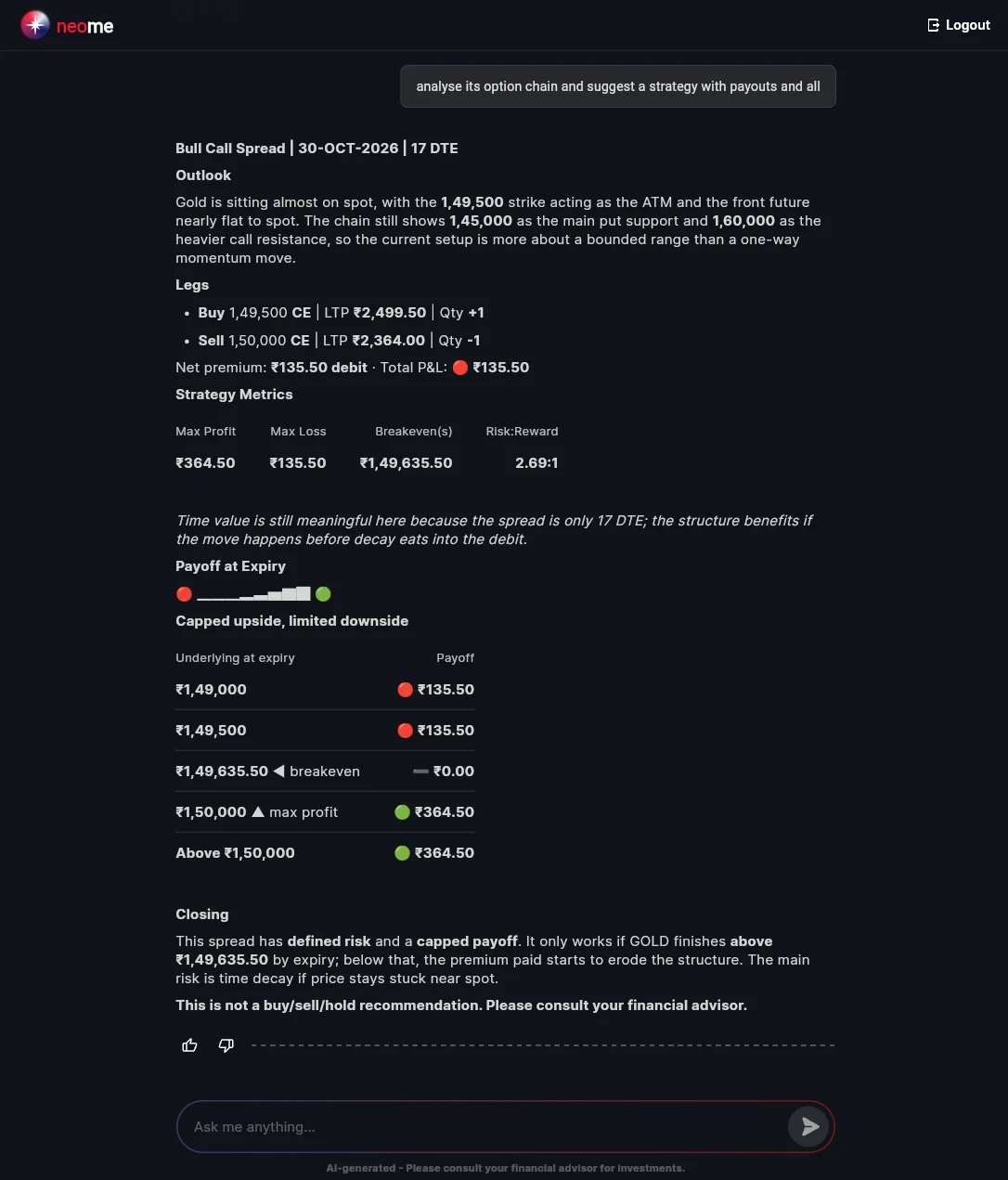
- F&O and commodities: option chains, futures, open interest and contract data, explained. It can lay out an options strategy with its payoff at expiry, as an illustration rather than a recommendation.
- Indices and the day's market: how a part of the market is doing, what moved today and why, with links to the news it used.
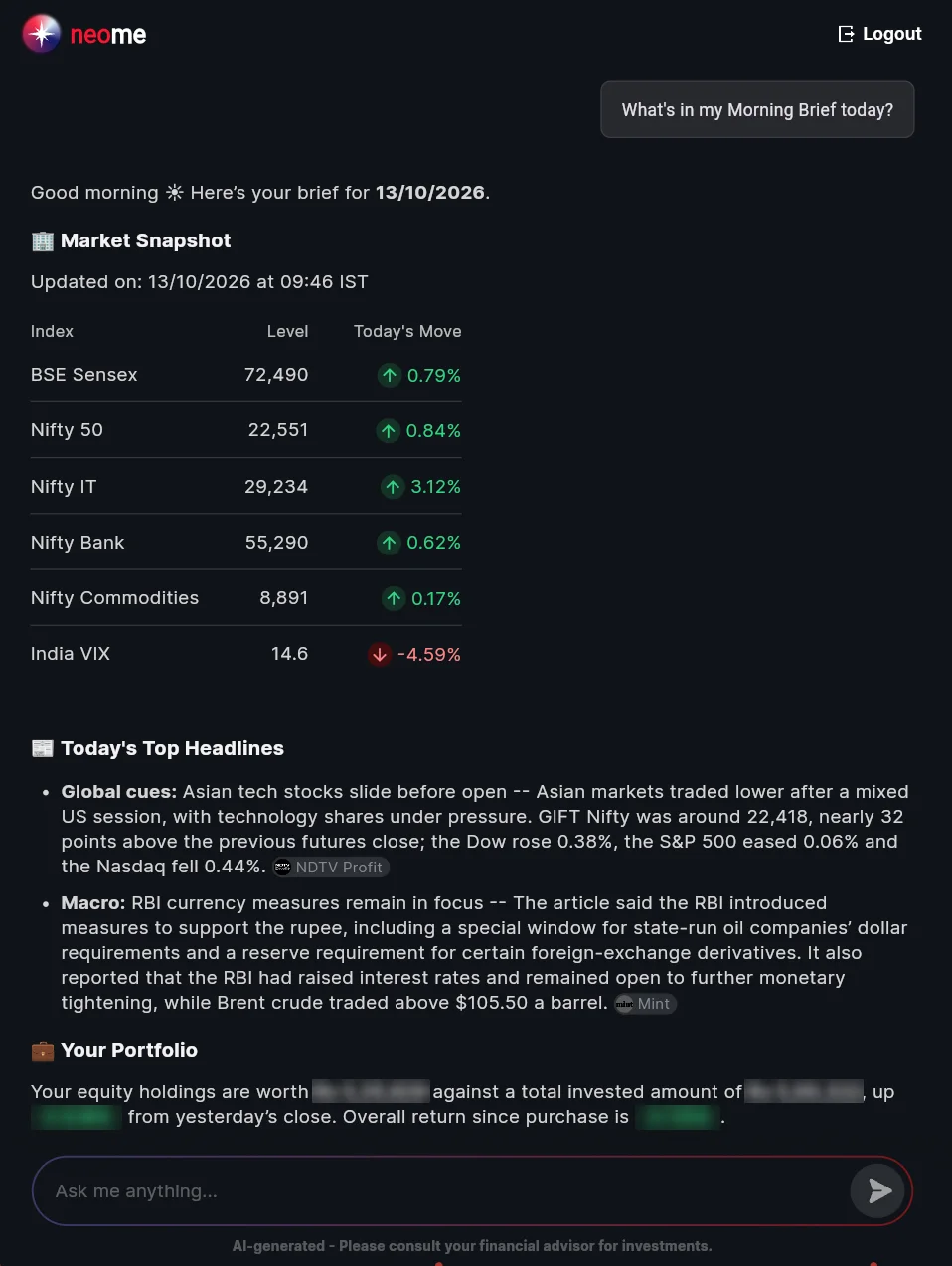
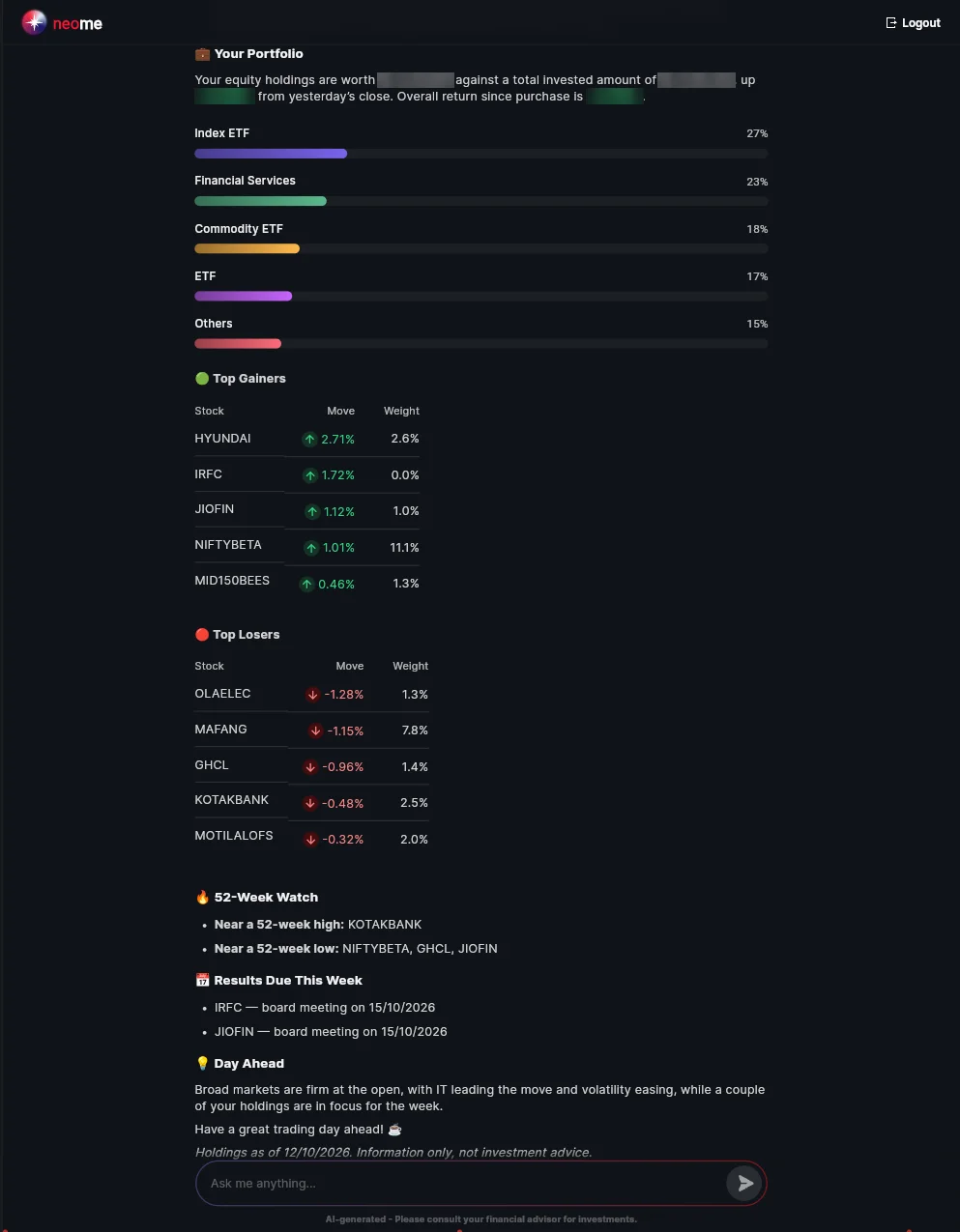
- Your portfolio: a summary, with context on each holding, and a Morning Brief each day with the market, the headlines and how your holdings moved.
It explains what the numbers mean rather than only showing them. It doesn't place trades, predict prices or tell you what to buy or sell. Retail investors use it every day.
What it looks like
Real answers to questions I asked. Charts, tables and payoff diagrams are drawn by the app itself, not pasted in as text.
What I do
- Technical direction for the assistant, from the first prototype to daily use, together with my team.
- Testing before release. I co-designed our test automation with my team. No single test can check everything, because models can’t judge it all reliably or cheaply. So we check separate things: does the answer fit the question, is it faithful to what the tools returned, and did we fetch the right information. Before every release we run it and decide from the results, however good the demo looked.
- Product thinking from the engineering side. We work alongside the product team, and I proposed several of Neome's product ideas, among them the Morning Brief, the F&O payoff tables and commodities coverage, which my team and the product team built together. Ideas come from everyone on the team. We discuss each one together and quickly build the ones that add value. There is always more to do than we have time for, so the highest-value work goes first. My engineering team reads real conversations and user feedback every day, sometimes talks to customers directly, and runs its own production monitoring and model evaluation, so what real users do shapes every product decision. No customer data appears on this page.
- The team. I built the first working version myself. I now lead three engineers, and I still build some of its key parts.
The loop we run
Figure 6 shows how my team works, not how the system is built. We watch how people use the assistant, talk to users, decide what to change, test it, release it, and watch again. The highlighted step is testing: before every release we run our automated tests and decide from the results, however good the demo looked.
Principles I follow
- I write the evaluation first, and if something gets worse, the release waits.
- If something simpler does the job, I delete my own work and use that.
- I keep the number of tools small, because every tool costs prompt tokens, can fail in its own way and needs its own security checks.
- The prompt can ask, but the code has to enforce. Anything that must always happen goes in code, and the model never gets to take an action that can't be undone.
- When a question is unclear, I resolve it in layers and test each layer on its own before blaming the model.
- When something fails, I let it show, repair it within a limit, and turn every repair into a new test.
Leadership, as principles
Engineers who think like product people. I don't wait for a spec. I read how the assistant behaves in production, look at what users actually ask, and bring a proposal with an evaluation attached. My team works the same way, and they often bring the sharpest user-level observations we have. In our team, a failing test case usually settles an argument faster than opinions do.
Leading and still building. I built the first working version myself, so early on most of the code was mine. I still build some of the key parts. Leading three engineers means deciding what to hand over, what I keep building, and what I review because it affects what we release. My team sits around me, so most reviews happen in person, and we talk the change through together.
Public proof of the same habits
I can’t share numbers from my day job. These come from personal projects I own, each published with its method. They are not Neome's numbers.
- Piaa. I cut the tool schema the model has to read to 2,412 tokens, and fixed a system prompt that changed every turn, which took the dead time before the first token to 214 ms.
- Slipstream. I designed a codec whose position error never goes above 0.556 m, however long the ride.
- makranddubey.com. I built a recovery pipeline that will not publish any text it cannot confirm.
Awards
- MD's Award, 2024
- Innovation Lab Champion, H2 2023-24
Methods, not metrics
I can't share numbers from my day job, as they belong to my employer. I will be glad to walk you through the methods and trade-offs on a call. Email me and we can set one up.