 amogh.cloud
makranddubey.com
Four Hindi books, rebuilt as a website and an app
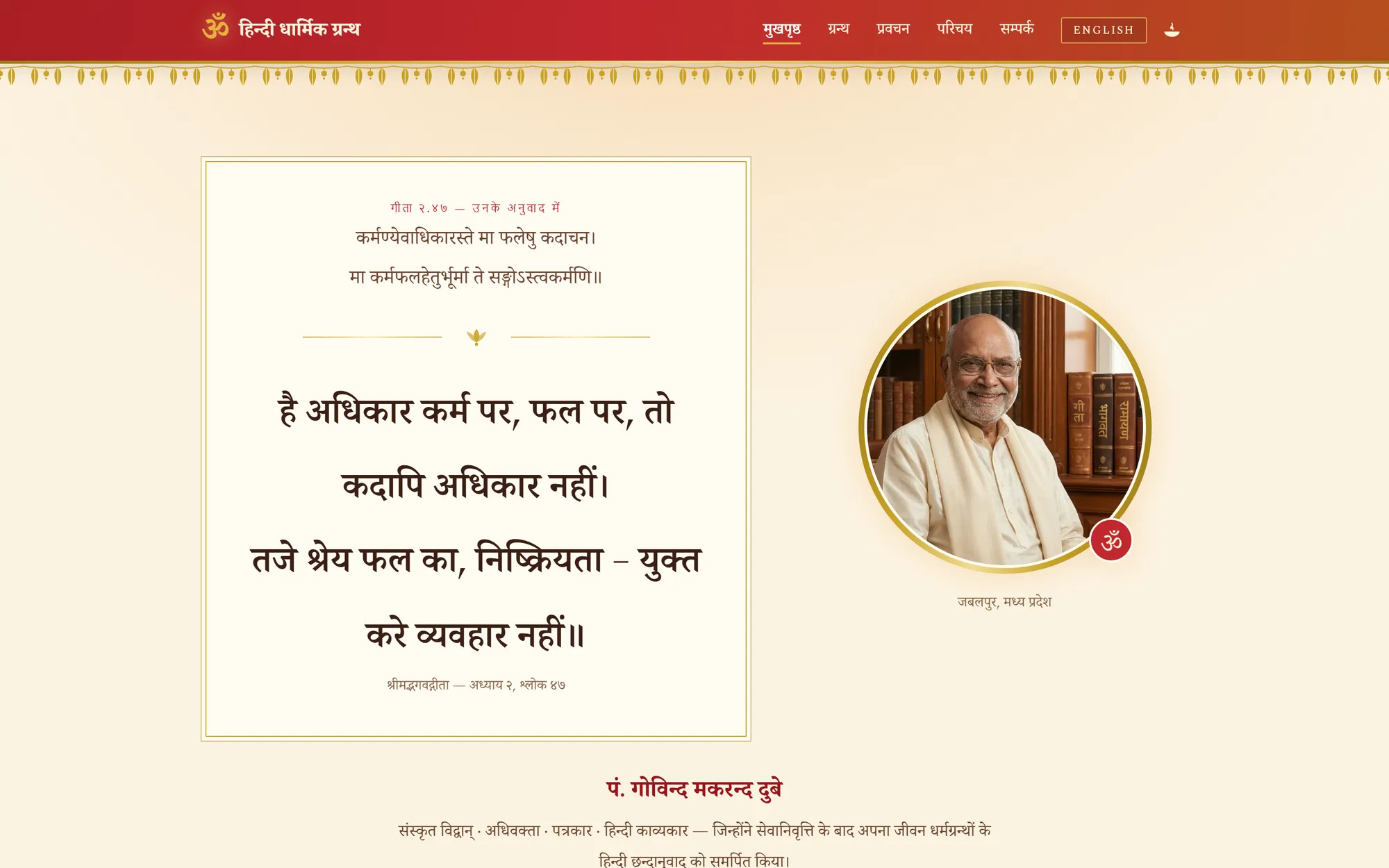
Four Hindi books existed only as print files that a computer could not read. I recovered the text, checked it against independent counts, and built a website and an Android reading app.
In short
Problem. Four published Hindi verse translations existed only as print files. You could read them on paper, but a computer couldn’t, so there was no search, no copying, no larger text on a phone, and the largest file was too big to open quickly.
What I built. I built a tool that reads the typesetter’s old PageMaker files, and a table that maps each old font code to the right Hindi letter, made from the typesetter’s own fonts. Checks flag anything uncertain, and the export refuses to publish broken letters. On top of that there is a website that opens large PDFs page by page, and an offline Android reader.
What I measured. I compared the recovered text with each book’s own counts. The Geeta and the Ramayana match exactly, and the Bhagwat is nine couplets off, which the check flags. I also measured what a browser really downloads to show the first page of the biggest book.
What it looks like
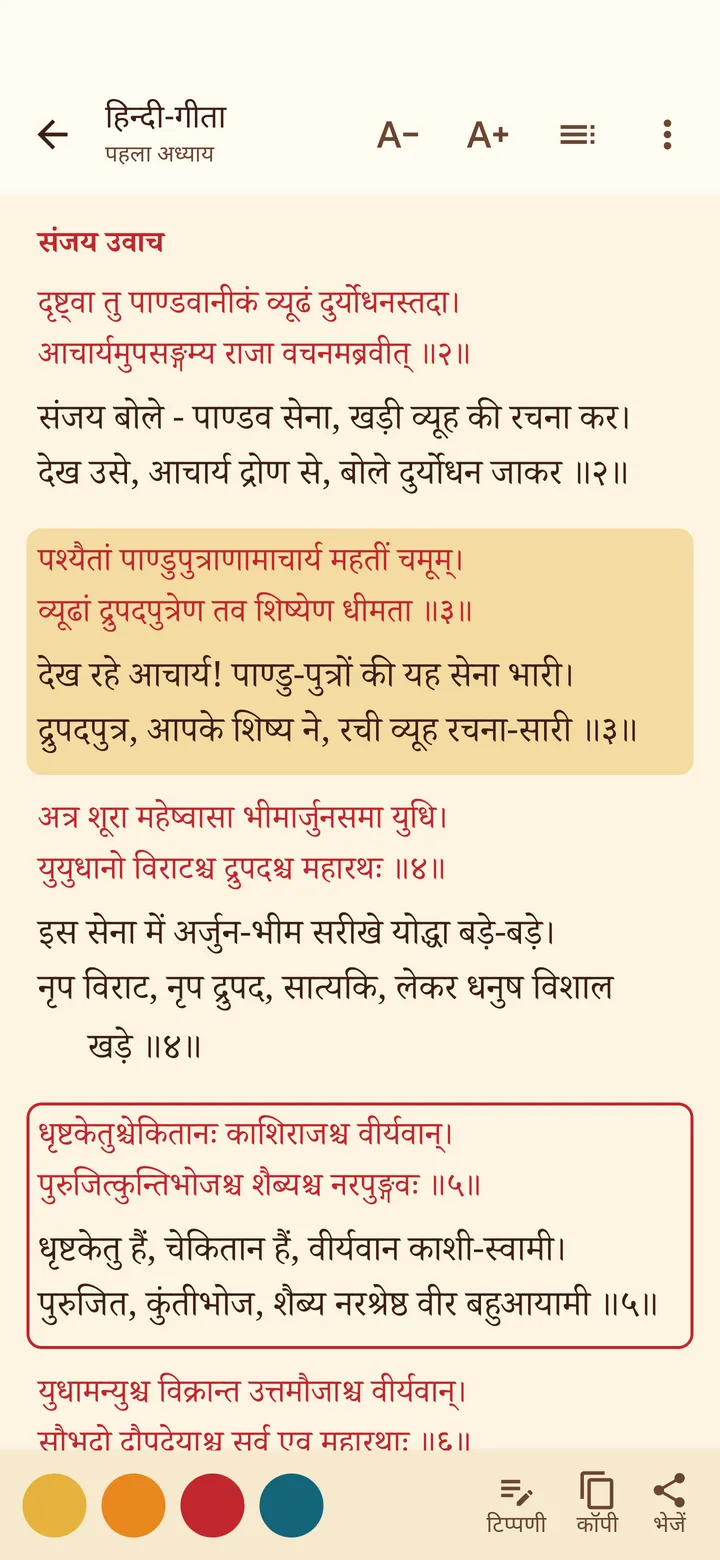
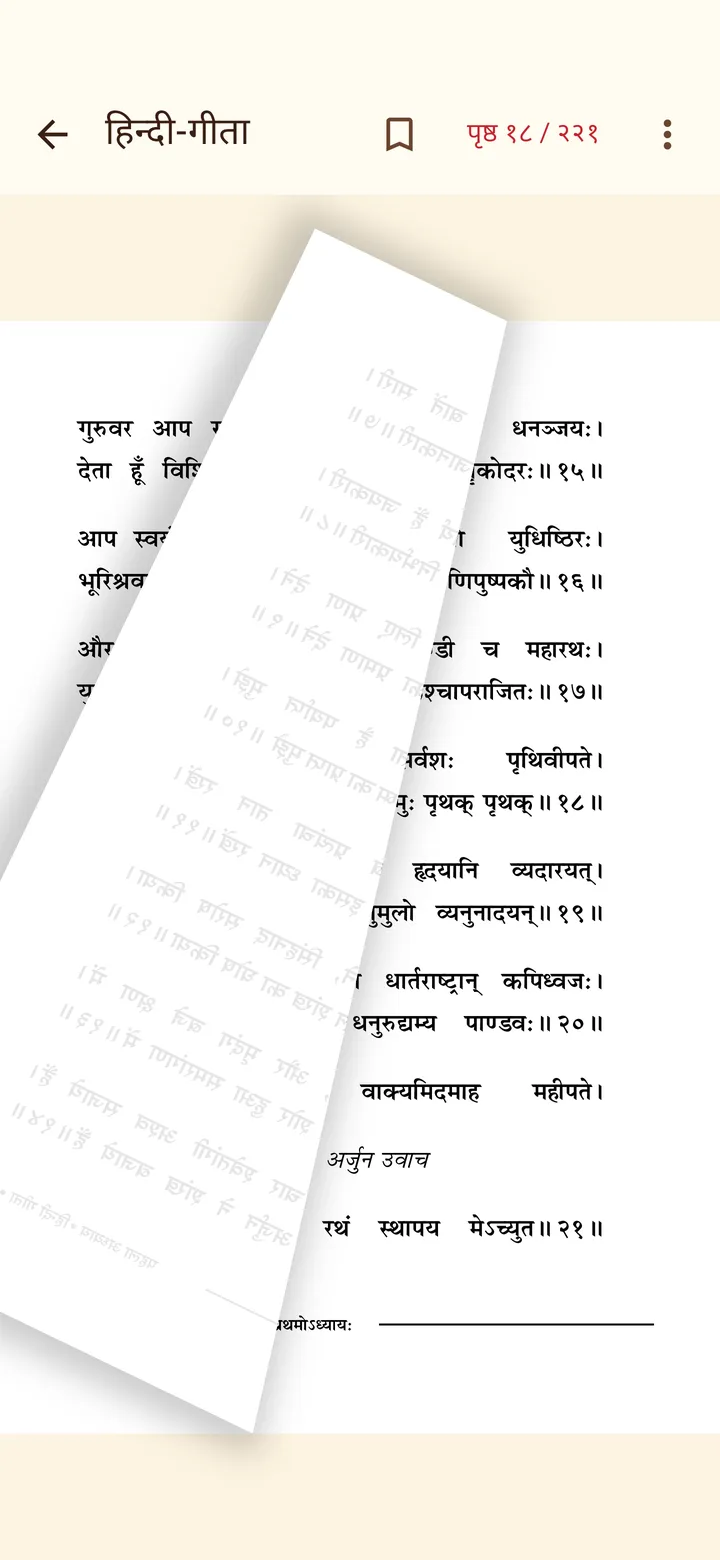
1 Context
Pt. Govind Makrand Dubey’s translations of the Geeta, the Bhagwat and the first volume of the Ramayana, plus a collection of navgeet songs, are read by Hindi-speaking devotional readers. I designed for readers who are often past fifty, on mid-range Android phones and patchy connections.
The books existed as print PDFs whose letters were drawn as shapes, so people could read them but computers could not. I started in February 2026 with a hand-written site, rebuilt it in Astro in August, and added the Android app in September.
2 Constraints
- Eight-bit legacy fonts. The typesetter used Chanakya-family fonts, which are not Unicode. Each byte in the file stands for one glyph of the font.
- No Unicode text anywhere. The only text was in the typesetter’s 8-bit font encoding, so every recovered line needed an independent check.
- A big PDF. The Bhagwat PDF is 58,156,094 Bsize of the Bhagwat PDF.Method total length reported by a ranged request to the live file.My check of the live file, 10 Oct 2026 · Measured by me58,156,094 Bsize of the Bhagwat PDF.Methodtotal length reported by a ranged request to the live file.SourceMy check of the live file, 10 Oct 2026ClassMeasured by me · 10 Oct 2026. GitHub Pages said it could send just part of a file (range requests) but returned the whole file, and Cloudflare Pages caps file size below that.
- No analytics, by design. The site’s privacy page promises no analytics, so I have no traffic numbers.
3 What I built
- A PageMaker reader that pulls text regions out of the typesetter’s binary files.
- A glyph table built by rendering the typesetter’s own glyph for each byte. A code I cannot confirm maps to a visible marker, so it can be audited in context instead of silently guessed.
- Checks, and a gate. The scripts that put each book together compare it against the book’s own counts and list any difference. The export refuses to publish if a hand correction doesn’t match exactly once, or if any vowel sign or mark is left with no letter to sit on.
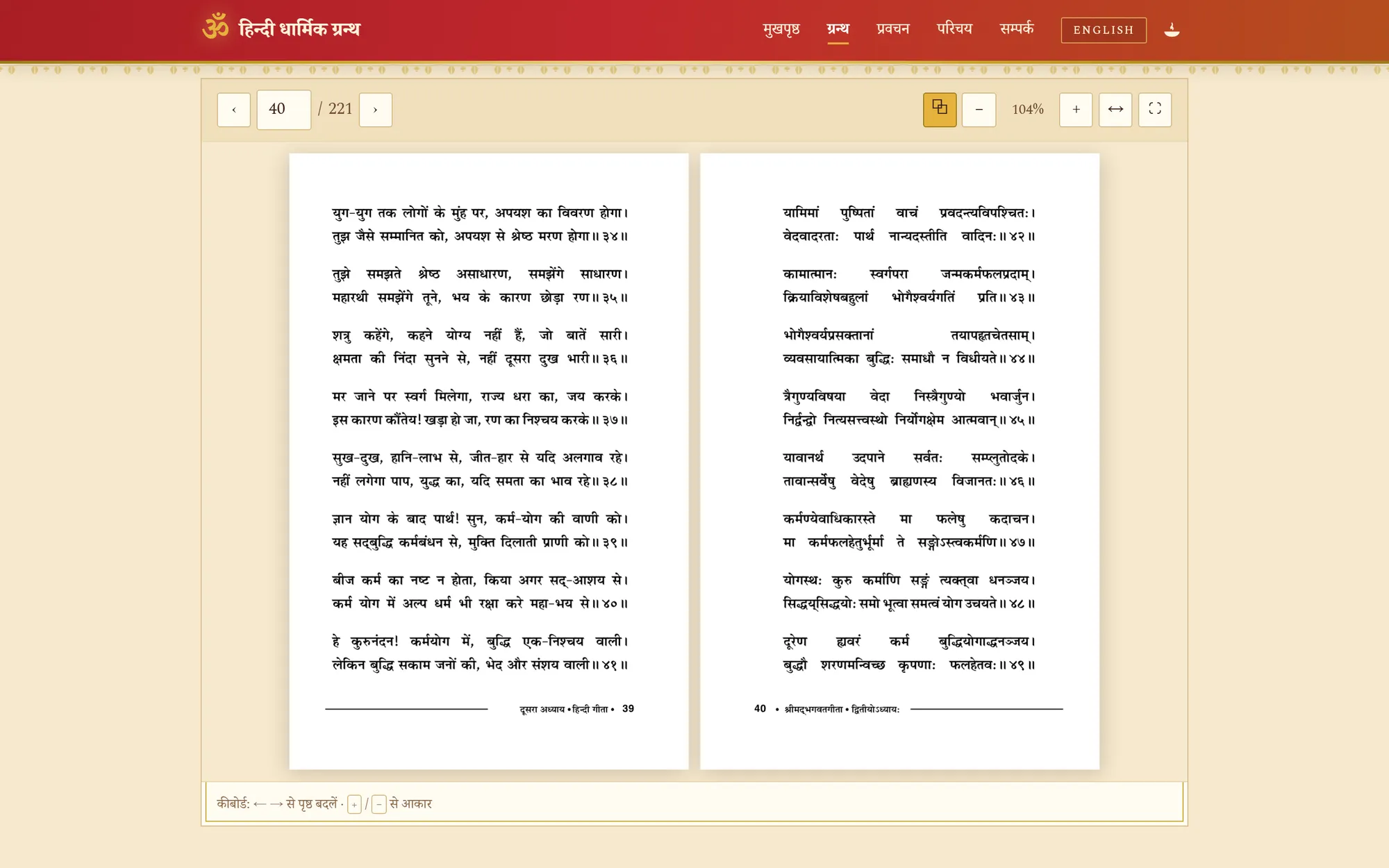
- A static site on Cloudflare, with the PDFs on object storage and read by pdf.js through range requests, so page one needs only 0.28 MBdata a browser downloads to show page one of the 58 MB Bhagwat in the site's reader; was about 66 MB, the whole file plus range requests, until 14 Oct 2026.Method Chromium with the cache off; every byte received from the file host, summed chunk by chunk, until page one was drawn; 1440x900 (0.31 MB at 390x844).Note Until 14 Oct 2026 the reader still fetched the whole file in the background, although the server answered range requests. I found it while checking this page.My measurement in a real browser, 14 Oct 2026 · Measured by me0.28 MBdata a browser downloads to show page one of the 58 MB Bhagwat in the site's reader; was about 66 MB, the whole file plus range requests, until 14 Oct 2026.MethodChromium with the cache off; every byte received from the file host, summed chunk by chunk, until page one was drawn; 1440x900 (0.31 MB at 390x844).NoteUntil 14 Oct 2026 the reader still fetched the whole file in the background, although the server answered range requests. I found it while checking this page.SourceMy measurement in a real browser, 14 Oct 2026ClassMeasured by me · 14 Oct 2026 of the biggest book.
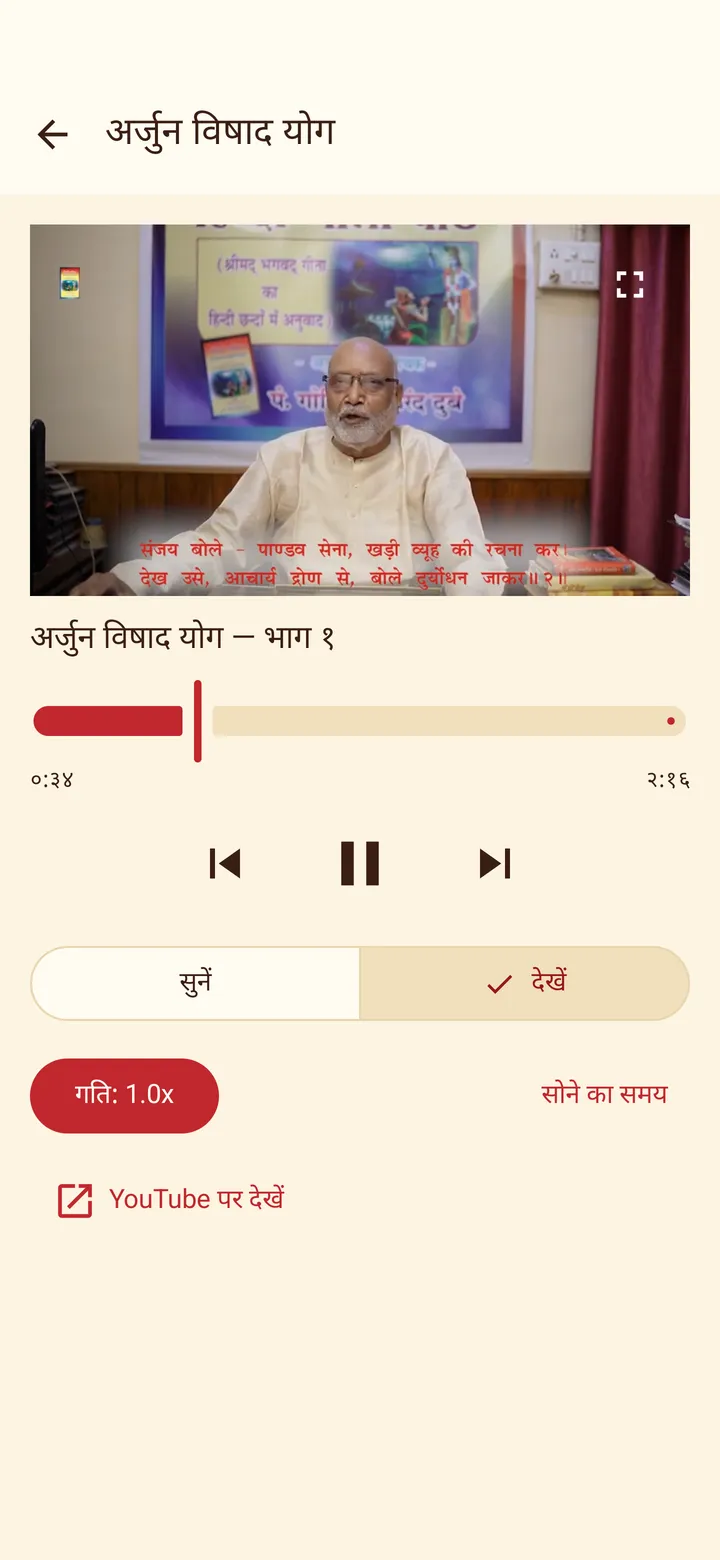
- An offline Android reader with audio, a page-curl reader, and a reflowable text edition with highlights and notes. Content is updated through a hash-versioned catalogue, so a correction needs no app release.
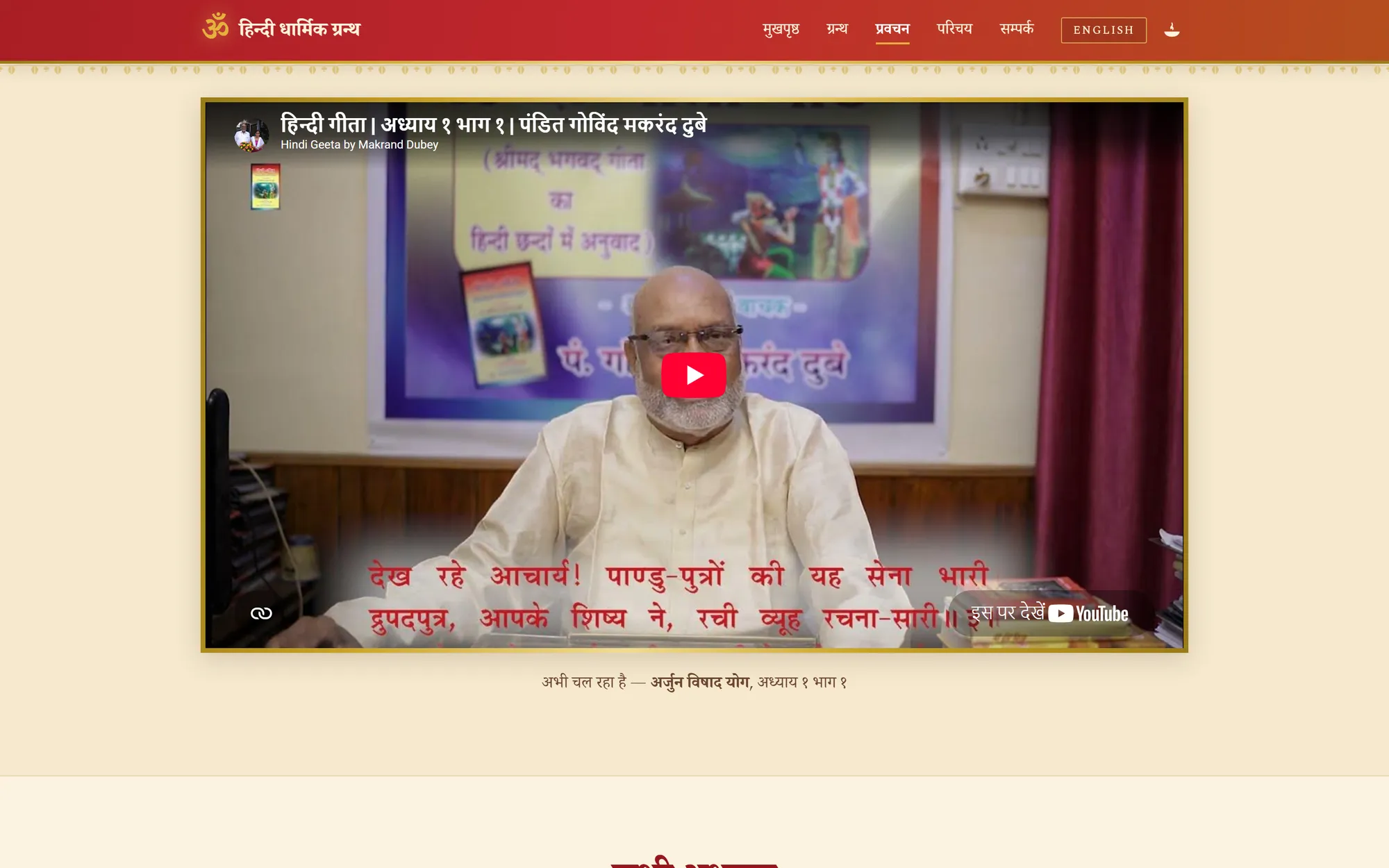
- His own recitations, offline. 50 recordingsrecitations of the Geeta across its 18 chapters, in the website and the app.Method count of recordings in the site's media list.My count of the project's files, 14 Oct 2026 · Measured by me50 recordingsrecitations of the Geeta across its 18 chapters, in the website and the app.Methodcount of recordings in the site's media list.SourceMy count of the project's files, 14 Oct 2026ClassMeasured by me · 14 Oct 2026 recordings of the Geeta, 171 minutestotal running time of those recordings.Method sum of each recording's duration in the site's media list.My count of the project's files, 14 Oct 2026 · Measured by me171 minutestotal running time of those recordings.Methodsum of each recording's duration in the site's media list.SourceMy count of the project's files, 14 Oct 2026ClassMeasured by me · 14 Oct 2026 in all. They’re served from the project’s own storage instead of being streamed from YouTube, which suits Google Play’s rules and lets them be saved for offline use. They keep playing with the screen locked, with controls on the lock screen, and can download on Wi-Fi only.
- Built for readers past fifty. The app is Hindi first, with Devanagari numerals everywhere. Text can grow as large as you like, and there is a night-reading mode. Each book has two plain buttons, one to read it as text and one to see the printed copy. Highlights work by tapping a verse, with no fiddly selection handles, and they’re tied to the verse number, so a correction to the text never moves them.
- Findable by search engines and AI assistants. The old site built its verse and recording lists with JavaScript, so search engines saw empty pages. Now everything is real HTML. Each page has structured data describing him and the books, the Hindi and English pages are linked as translations of each other, and an
llms.txtfile tells AI assistants who he is. Old addresses still work, and the pages cited by his Hindi Wikipedia article redirect permanently to the new ones. - No accounts, no ads and no analytics, on the website or in the app.
1 · Legacy bytes (8-bit font, from the print file)
6A6B656B3B2E6B
2 · Glyph table (one entry per code, built from the typesetter's own glyphs)
- रा
U+0930U+093E - मा
U+092EU+093E - य
U+092F - ण
U+0923
- रा
3 · Unicode Devanagari
रामायण
Unconfirmed code: A code the table cannot confirm stays visible as a pen-marked circle, so it can be checked in context. It is never guessed.
The count gate refuses to publish when the recovered text does not match the printed count, for example 4,567 couplets in one book.
4 Measurements
| Reading | What it shows |
|---|---|
| 1,301 lines1,301 linesPython in the recovery pipeline that turns legacy typesetting files into Unicode text.Methodline count of the tracked Python files in the recovery tools.SourceMy count of the project's files, 10 Oct 2026ClassMeasured by me · 10 Oct 2026 | The recovery pipeline: legacy-font decoding, PageMaker reading, assemblers, export. |
| 3.59 MB3.59 MBthe text edition of all four books as structured JSON.Methodsum of the four JSON file sizes in the site's public folder.SourceMy count of the project's files, 10 Oct 2026ClassMeasured by me · 10 Oct 2026 | The text edition of all four books. |
| 700 of 700 verses700 of 700 versesGeeta verses recovered, against the book's own count.Methodrecovered text compared with the book's own verse count.SourceThe book's own count, checked by my pipeline, 2026ClassPublic source · Oct 2026 | Geeta verses recovered, matching the book’s count. |
| 4,576 couplets4,576 coupletscouplets in the recovered Bhagwat text.Methodlines ending in a double danda across all chapters, counted by the Bhagwat assembler.NoteNine more than the back cover. The pipeline lists the chapters where verse numbering jumps, to check against the printed pages.SourceMy recovery pipeline's report, Oct 2026ClassMeasured by me · 14 Oct 2026 against 4,567 couplets4,567 coupletscouplets printed on the Bhagwat's back cover.Methodrecovered text compared with the figure printed on the book's back cover.NoteAn earlier version of the site said 18,000 verses. That is the source Purana's count, not this book's.SourceThe book's own back-cover count, checked by my pipeline, 2026ClassPublic source · Oct 2026 | Nine couplets more than the back cover, for the Bhagwat. The check flags the difference instead of hiding it. |
| 77 of 77 sargas77 of 77 sargasBalkanda sargas recovered, against the standard Gita Press count.Methodrecovered text compared with the standard Gita Press sarga count.SourceGita Press sarga counts, checked by my pipeline, 2026ClassPublic source · Oct 2026 and 119 of 119 sargas119 of 119 sargasAyodhyakanda sargas recovered, against the standard Gita Press count.Methodrecovered text compared with the standard Gita Press sarga count.SourceGita Press sarga counts, checked by my pipeline, 2026ClassPublic source · Oct 2026 | Ramayana sargas recovered, matching the standard counts. |
| 0.28 MB0.28 MBdata a browser downloads to show page one of the 58 MB Bhagwat in the site's reader; was about 66 MB, the whole file plus range requests, until 14 Oct 2026.MethodChromium with the cache off; every byte received from the file host, summed chunk by chunk, until page one was drawn; 1440x900 (0.31 MB at 390x844).NoteUntil 14 Oct 2026 the reader still fetched the whole file in the background, although the server answered range requests. I found it while checking this page.SourceMy measurement in a real browser, 14 Oct 2026ClassMeasured by me · 14 Oct 2026 | Data a browser downloads to show page one of the Bhagwat, after the fix. |
| 13 of 13 tests passed13 of 13 tests passedunit tests passing in the Android reader.Methodrelease unit-test run.NoteThe reader has three small test classes, not a full suite.SourceMy test run, 14 Oct 2026ClassMeasured by me · 14 Oct 2026 | The reader’s unit tests on 14 Oct 2026. |
On 14 Oct 2026 I measured what a browser actually downloads, not just whether the server supports ranges.
5 What broke
- The check that passed and the reader that didn’t. I had confirmed the server sends only the bytes asked for. But when I measured what a browser actually downloaded, the reader was still pulling the whole Bhagwat file in the background, because one setting stopped extra page requests while another kept the first request streaming the entire file. One line fixed it. Page one now needs 0.28 MBdata a browser downloads to show page one of the 58 MB Bhagwat in the site's reader; was about 66 MB, the whole file plus range requests, until 14 Oct 2026.Method Chromium with the cache off; every byte received from the file host, summed chunk by chunk, until page one was drawn; 1440x900 (0.31 MB at 390x844).Note Until 14 Oct 2026 the reader still fetched the whole file in the background, although the server answered range requests. I found it while checking this page.My measurement in a real browser, 14 Oct 2026 · Measured by me0.28 MBdata a browser downloads to show page one of the 58 MB Bhagwat in the site's reader; was about 66 MB, the whole file plus range requests, until 14 Oct 2026.MethodChromium with the cache off; every byte received from the file host, summed chunk by chunk, until page one was drawn; 1440x900 (0.31 MB at 390x844).NoteUntil 14 Oct 2026 the reader still fetched the whole file in the background, although the server answered range requests. I found it while checking this page.SourceMy measurement in a real browser, 14 Oct 2026ClassMeasured by me · 14 Oct 2026.
- The dotted circle. The typesetter used a visarga, a Devanagari sign, as a colon. My phone’s font hid it, but Noto Serif drew it as a dotted circle. The export now converts it and applies a hand-correction list in which each entry must match exactly once. In all, 8 stringsstrings changed by the dotted-circle fix, three in the Bhagwat and five in the Ramayana footnotes.Method count of hand-corrected strings, each of which must match exactly once or the export refuses to run.Note The Geeta and the navgeet collection came through byte-identical.My export script, Oct 2026 · Measured by me8 stringsstrings changed by the dotted-circle fix, three in the Bhagwat and five in the Ramayana footnotes.Methodcount of hand-corrected strings, each of which must match exactly once or the export refuses to run.NoteThe Geeta and the navgeet collection came through byte-identical.SourceMy export script, Oct 2026ClassMeasured by me · Oct 2026 changed. The Geeta and the songs came through byte-identical.
- “curl proves it works” was wrong. The reader failed in every browser. curl sends no CORS preflight, but the browser’s preflight was refused, and a stale cached response hid my first fix. A CORS policy on the bucket and a cache-busting query string fixed it.
- Two-up spreads. Every PDF page held two logical pages side by side, so phones showed two half-size pages. The split script checks that the centre gutter is blank before it cuts.
- My own site’s claim. The first version said the Bhagwat has 18,000 verses. That is the count in the source Purana, not in this book. The book has 4,567 couplets, and I corrected the site.
6 What I’d change
- Audience numbers. The site has no analytics, by design. If I ever add measurement, the privacy page changes first.
- Scope. The Ramayana here is volume one, which covers two of the seven kandas. The counts above are the template for checking the rest.
7 Credits and disclosures
- People: Pt. Govind Makrand Dubey, whose translations these are, and the books’ publisher. Shared with the author’s permission.
- Open source this stands on: Astro, pdf.js, pdf-lib, Noto Serif Devanagari (OFL), Kotlin and Jetpack Compose, Media3 and a PageCurl library.
- Tools: I owned the product, the reading experience, the recovery pipeline and its checks, and tested on a physical phone. AI coding agents help me write code faster.
Details
- Role
- Product owner, designer and builder
- Dates
- Feb 2026–now
- Status
- Stack
- Python, Astro, Cloudflare R2 and Workers, pdf.js, Kotlin and Compose
- Built with
- Product owner, designer, architect and tester. AI coding agents for speed.
Talk to me about this
Questions about the method, or something I got wrong? Write to me.
 Or ask Baby Piaa, my AI assistant, about makranddubey.com